COSM is the educational set of courses focused on cultural management and organisational change regarding wide range of sustainability values. The idea behind the COSM is exploring and sharing the way we undo the unsustainable in cultural management, with all the respect to the creative processes, projects and realities that used to be and in fact continuously are unsustainable in its core.
Find the new COSM courses (the renewed 8th edition)
COSM 1. CULTURE, ORGANISATION and SUSTAINABILITY will start in September – 11.9.2025 (with the registration until 28.8.2025) – Read more about the course’s content, schedule and assignments.
COSM 2. CREATIVE PROFESSIONALS and SUSTAINABILITY– will start in February – 5.2.2026 (registration until 21.1.2026)
If you are student of any Finnish university of applied sciences or your Finnish university is included into RIPA – Cross-institutional studies – the courses are available without fee through your PEPPI courses registration system. Otherwise you can buy the access to all courses by registering on Humak University Open University Web Shop.
COSM is Finnish but in English, made by HUMAK but offered to Finnish and international audience, it is rooted in the experience of: international researchers, academic teachers and global range practitioners as well as local talents: participants and partners involved creative hubs, local organisations, and cultural institutions.
The triplet of COSM 1, 2, 3 ended in the Spring of 2025 as its COSM 7th edition.
The NEW COSM structure with renewed COSM 1 and COSM 2 starts in the Autumn semester of 2025. COSM 1. CULTURE, ORGANISATION and SUSTAINABILITY will start in September – 11.9.2025 (with the registration until 28.8.2025) – Read more about the course’s content, schedule and assignments.
COSM 2. CREATIVE PROFESSIONALS and SUSTAINABILITY– will start in February – 5.2.2026 (registration until 21.1.2026)
The logic behind the new COSM 1 is to provide the panoramic view (macro level) on culture, arts and sustainability values seen through perspective of organisations, while the new COSM 2 brings focused view (the micro-level) on culture and sustainability: the perspective of individual CCS (Cultural and Creative Sectors) professional.
The first side of both COSM corses is the one that acknowledge, adapt and strengthen the role of cultural professionals in supporting the general sustainability movement, impacting people’s and industries’ pro-ecological behaviours, assisting all types of attempts to make our life more sustainable, ethical, responsible or balanced – in environmental, social, economic sense.
The second perspective of COSM courses is the one from the inside of cultural and creative ecosystems. To strengthen sustainability values-oriented practices of leaders and employees of culture, art & heritage organisations’, as well as culture & arts entrepreneurs. This include: the quality of organisational cultures, the range and accessibility of professional development conditions, non-toxic leadership, synergetic and participative cultural policies as a soil for cultural management practice, ethical and balanced cultural work environment. This is all about providing tools and conditions for a sustainable, healthy, ethically concerned cultural management ecosystems. We require a refreshed perspective on the impact of cultural policies’ political trends and conditions on the cultural management practice. Sustainability values oriented cultural management might be the answer.
To make COSM more open to everyone interested in sharing ideas, practices and developing new ways to look at the issues related to sustainability and cultural & arts management we organised broadly accessible online roundtable “COSM Talks” with most creative and intriguing international experts we know, who have curiosity and experience in re-thinking our sustainability values that should be applied to cultural organisations’, cultural managers’ and cultural entrepreneurs’ everyday practice. Those talks were foundational to our concept of COSM.
Read a short article about COSM (COSM chapter Humak 2022) – published in December 2022 – as a summary of the experiences of few first editions that are now continued in the NEW COSM courses – refreshed from the Autumn 2025 as two harmonised but independent learning modules: COSM 1: Culture, Organisation and Sustainability and COSM 2: Creative Professionals and Sustainability.
5 reasons to study (Humak) COSM courses:
COSM is the unique chance to:
1) get the international and cross-sectorial perspective on the sustainability values oriented cultural management and rediscover it’s meaning in collaborative spirit
2) join the team of people exploring sustainability-oriented solutions with experts, cultural managers and cultural producers in their organizational and entrepreneurial contexts, developing sustainability management rooted in the core of humanities and arts as academic, applied disciplines of science and practice
3) use safe space for questioning the answers regarding cultural organizations and cultural professionals’ role in balancing their ecosystems, redefining their way of narrating what they (un)do, with what tools or methods, and how they are impacting their local communities
4) be the part of regular webinars and discussions with international & regional experts and practitioners focused on culture & sustainability, to strengthen sustainability values-oriented practices of leaders and employees of culture, art & heritage organisations’, as well as culture & arts entrepreneurs and NGO’s members
5) take part in the courses’ activities and assignments that are facilitating several dimensions of your potential: interaction, cooperation, reflection, written argumentation and dialogue in conversation, all aiming to have effective role of cultural managers in supporting all types of attempts to make our cultural ecosystems and our life more sustainable, ethical, responsible or balanced – in environmental, social and economic sense.
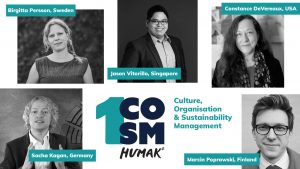
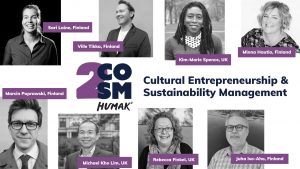
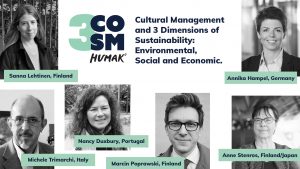
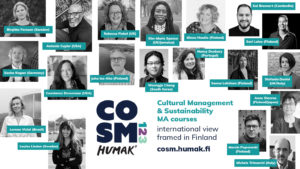
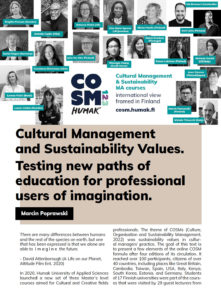
Find below the preview of the lecturers of COSM editions 1-7. (2020-2025)
Christian de Beukelaer (University of Melbourne, Australia) | Kai Brennert (edgeandstory, Cambodia) | WoongJo Chang (Hongik University in Seoul, South Korea) | Antonio C. Cuyler (University of Michigan, USA) | Constance DeVereaux (University of Connecticut, USA) | Stefania Donini (Paisley Museum, UK) | Nancy Duxbury (University of Coimbra, Portugal) | Rebecca Finkel (Queen Margaret University, Edinburgh, UK) | Annika Hampel (University of Freiburg, Germany) | Minna Hautio (Humak UAS, Finland) | Juha Iso-Aho (Humak UAS, Finland) | Sacha Kagan (Leuphana University, Germany) | Michael Kho Lim (University of Glasgow) | Noora-Helena Korpelainen (University of Helsinki, Finland) | Sari Laine (Sitra, Finland) | Sanna Lehtinen (Aalto University, Finland) | Louise Linden (LiveGreen, Sweden) | Benny Majabacka (Humak UAS, Finland) | Birgitta Persson (Future by Lund, Sweden) | Marcin Poprawski (COSM coordinator, Humak UAS, Finland) | Anthony Schrag (Queen Margaret University, Edinburgh, UK) | Anna Scuttari (University of Munchen, Germany / Eurac Research, Italy) | Daniel Silver (University of Toronto, Canada) | Kim-Marie Spence (Queen’s University, Belfast, UK / Creative Kingston, Jamaica) | Anne Stenros (Creative Catalyst, Finland / Nagaoka University of Technology, Japan) | Michele Trimarchi (Tools for Culture, Italy) | Lorena Vicini (Instituto Inhotim, Brazil) | Jonathan Vickery (University of Warwick, UK) | Jason Vitorillo (Lasalle University, Singapore) | Ville Tikka (Poem, Finland)