COSM functioned from the Spring 2021 until the Summer 2025 as the COSM1-2-3 courses pack three MA level courses (3 x 5 ECTS) focused on cultural management and organisational change regarding wide range of sustainability values.
From the Autumn 2025 on, COSM pack comprises of the 2 new updated courses: COSM 1 and COSM 2 and is supplemented by another course (AECO Audience Engagement and Creative Organisation).
The content below is an archived collected overview of the COSM courses terminated in April 2025. If you want to follow the NEW edition of COSMs – find more information on the new COSM 1. Culture, Organisation and Sustainability and the new COSM 2. Creative Professionals and Sustainability or the AECO Audience Engagement and Creative Organisations course.
COSM is the unique chance to:
1) get the international and cross-sectorial perspective on the sustainability values oriented cultural management and rediscover it’s meaning in collaborative spirit
2) join the team of people exploring sustainability-oriented solutions with experts, cultural managers and cultural producers in their organizational and entrepreneurial contexts, developing sustainability management rooted in the core of humanities and arts as academic, applied disciplines of science and practice
3) use safe space for questioning the answers regarding cultural organizations and cultural professionals’ role in balancing their ecosystems, redefining their way of narrating what they (un)do, with what tools or methods, and how they are impacting their local communities
4) be the part of regular webinars and discussions with international & regional experts and practitioners focused on culture & sustainability, to strengthen sustainability values-oriented practices of leaders and employees of culture, art & heritage organisations’, as well as culture & arts entrepreneurs and NGO’s members
5) take part in the courses’ activities and assignments that are facilitating several dimensions of your potential: interaction, cooperation, reflection, written argumentation and dialogue in conversation, all aiming to have effective role of cultural managers in supporting all types of attempts to make our cultural ecosystems and our life more sustainable, ethical, responsible, or balanced – in environmental, social, and economic sense
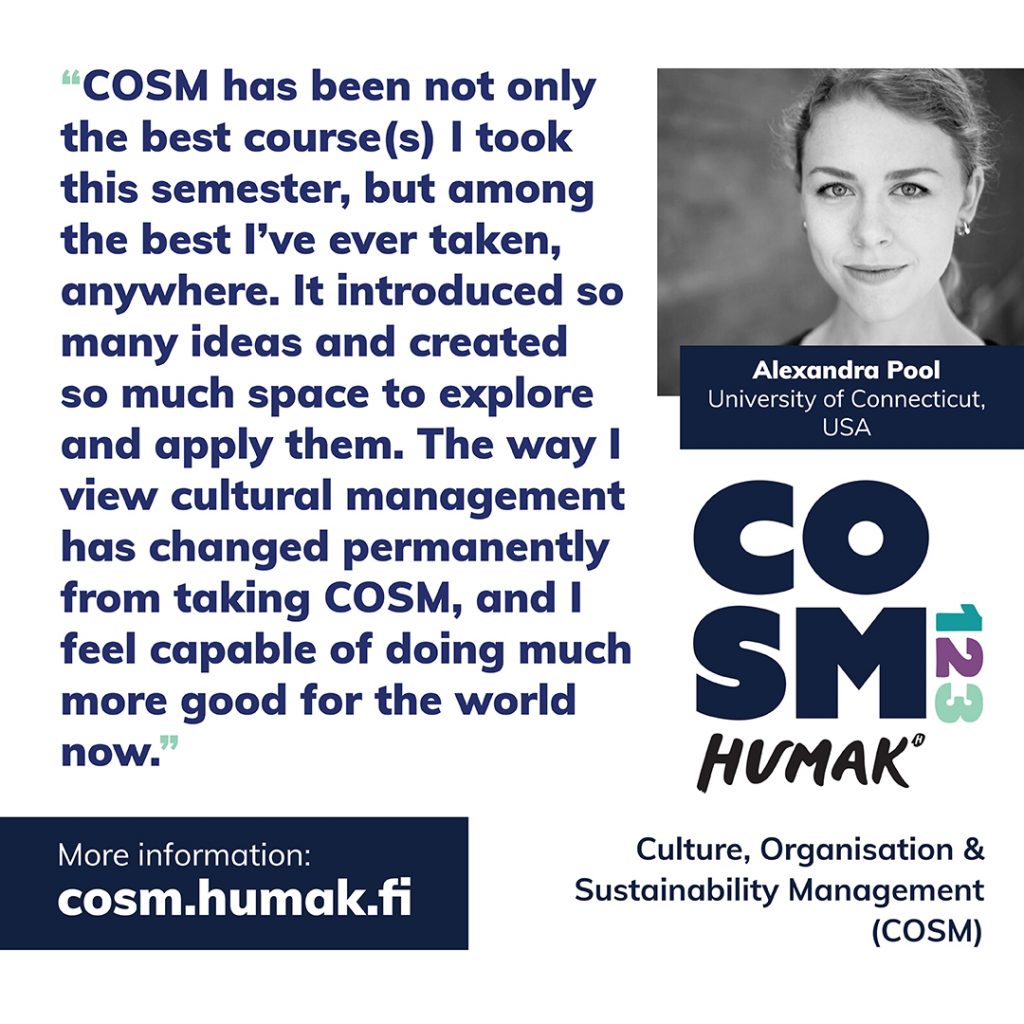
Experiences and testimonials of participants of the first edition of COSM 1 (Spring 2021):
I have been before in couple of sustainability development courses, but absolutely this gave me more knowledge of cultural and social aspects of sustainability. International experts of sustainability development from all over the world were a wonderful way to lead deep into sustainability subjects. The course gives a confident feeling of study with expertise and passion. The best in COSM 1 course were the inspirational speakers, their experience, and thoughts. There came up a pile of good books about sustainability and research materials to read. I got a lot of to think about the role of cultural work in sustainability. Tuula Hänninen
COSM course was one of the best I have participated. I learned and found some ways where and how I would like to develop my own possible career in the cultural sector. Course structure was efficient and comfortably inclusive. I really enjoyed it. I understood that my idea of sustainability might be in the heart of being a human and this course strengthened the concept about it. I know how to put what is learned into practice. Everyone, who intend to be in the managing position in the field of culture and art, should participate in this course. Sofia Palmio
The course provided a clear, in-depth, and demanding introduction to the sustainability theme. The subject was dealt extensively, that is, we went as far as the deepest waters. The speakers were well chosen and well prepared. There were interesting discussions. The assignments covered the academic part as well as one’s own creative work. I got a very clear picture of sustainability and its challenges not only in cultural production. I recommend prospective students to choose this course. Salla Raunio
This course was just what I hoped but did not expect. All my expectations were filled. The best of this course was all inspiring visitors. I felt so privilege to hear leading experts of sustainability development from over the world. The way the course was facilitated is very encouraging, polite, and inspirational. The courses support each other well and are connected. anon.
The lecture of Birgitta was the concrete that I needed! I had found the base to build on. I stopped to struggle, I turned back and grasped to my simple thoughts of what is sustainability. There it was, everything depends on how we treat and tolerate each other, how we listen, and do we hear at all? It is about our everyday life! How we live our lives and how willing we are to make the necessary changes? We as artists, managers, producers are in the key role in influencing the change inside of every individual. In my profession I can be the prime operator to change. By creating new stories to tell, new narratives, by developing new forms of interaction and new horizons to reach, I can direct all these individual minds towards a common goal and give the silent and forgotten voices a tone. Mayreth Wolff
I would like to point out that COSM 1 has indeed led me to seeing sustainable development in a different way, we should acknowledge sustainability is a concept of community-based thinking. Environmental, Social and Economic issues can be addressed and integrated in multiple ways and indeed we should keep this process open and exploratory. Lena Hüttl
COSM 1 biggest learning was to focus on good management and leadership that improves our wellbeing and functioning at work. Jiri Ahonen
I have been thinking a lot about a sustainability viewpoint in everyday life and especially in cultural productions while studying cultural management for three years now. Gladly for me we’ve got a new lecture and started this COSM. I got exited, because I would really like to be a wise producer when it comes to sustainable development. I do not want to produce anything which is unnecessarily heavy for the environment or to the organization I am working at. I appreciate the values, great work atmosphere and clear aims. And that is why I am glad I took this course; I learned a lot about the sustainability in organizations and in different kind of fields in cultural sector. I think that there were a lot of great material in the course contents! Sustainable leadership is something which I am going to carry on as a term on my future work paths. Tessa Ylinen
I really liked this course and webinars and all guest lecturers, speeches, interactions, and exercises. It was inspirational to hear guest lecturers’ examples and knowledge about these matters. Same was to see all the tandem videos. I really like watching them and wanted to give at least a comment for every tandem. All webinars and materials and answers to our questions were great. This course was full of knowledge, and I will use information with my future projects, with my own manager duties, I will put my efforts to do it with sustainability! Leena Vanhamäki
All in all, COSM taught me a lot of different sustainability valued aspects of thinking. Hopefully these thoughts will help me to be a better – and more sustainable cultural manager. Jussi Artiola
I think that this course was a great wholeness. There was a lot of (useful) information. I learned a lot and it was great to have such a versatile group of students. I think that there was a good number of assignments and the quality of those were suitable. anon.
Experiences and testimonials of participants of the first edition of COSM 2 (Spring 2021):
This course gave me a deeper understanding of the different aspects of sustainability, especially in the NGO sector. It is a source of endless information. We had very inspiring guest lecturers. Group work was great platform for discussions. My knowledge and awareness of this wide topic increased significantly. Pia Repo
During COSM 2 I was often able to reflect on my own experience in my small hometown in Germany and how the theater I am part of succeeds in transmitting cultural sustainability. It helped me in valuing more what we are doing as a cultural organization in my hometown, and I feel that it will also help other members of the organization in recognizing the importance of their voluntary work. The associations I had with my own experience during course sessions while discussing the pre-reading papers, lead me to see the voluntary work I do for our theater in a new light. I knew that the community values what we do, but I never thought of acknowledging that we are fostering actually cultural sustainability in our small-town community. Sustainability is not only about carbon emissions and green energy, but also about local cultural identity, local cultural practices and intergenerational transmission of cultural values and believes. Intergenerational learning is something beautiful and I wish for everyone to experience it. Transferring knowledge and cultural practices in this way has enriched my life. Through COSM 2 I came to realize, that it is actually a great example of cultural sustainability. Lena Hüttl
The teamwork model developed is fantastic. It made it possible to internalize and learn a completely insane amount of information in such a short time. Drilling alone would have taken all the power, and learning would not have been so effective. This method of giving space to learning is the best example of the principles of sustainable development in teaching. In this course I have understood perhaps more than ever the principles of sustainability. The teamwork has been fruitful, and I think I have already been able to implement the tools of sustainability in my own work. The course brings out the best in each of us. Mayreth Wolff
I enjoyed the structure of the course, especially working in the group. Teammates of our group helped me with my questions. I learned much of myself, my studying habits, and get a clearer vision of my future practices. Cultural sustainability shows itself to me as a very broad and appropriate subject to study and implement in the field. Well, I have developed and learned how to express myself and my thoughts of this subject and how it could be related in entrepreneurship in the field of Creative and Cultural Industry with so many levels and approaches. I graded this course 5/5 for myself relying on my learning process and thoughts shared to other students. No more marketing speeches 🙂 but humanistic approaches in more multidimensional perspective. COSM 2 entrepreneurial sustainability education in a wider perspective than “please, recycle your plastics” is necessary. Sofia Palmio
This course gave many good tools and inspiration to my work. COSM should be obligatory to all. Tuula Hänninen
The assignments were interesting and different from the COSM 1 course: reading, reading conversations, chewing things up. On the other hand, a lot of examples of special and working projects. All in all, the COSM courses have been extremely important, the most essential things have come up in these courses because the world is viewed so holistically! This course should be compulsory!!! The COSM 2 course, both the speakers and the texts, offered us many examples, or rather success stories of local, small scale action and events that had recreated local valuation of common place and community through art. Cultural producers should more often have the courage to go local. If cultural producers want to act in the frontline of sustainable development, we need to have a clear vision of our role and the future we create. Therefore, all our actions should be guided by questions like ‘who we are’, ‘what the world is like’, ‘what it is to be a human’, and ‘what is good and bad’. In the end, it is about knowledge and self-understanding. As we are meaning-makers in the true sense of the word, we should not feel insecure and prepare for probable futures, but anchor according to what is desirable and sustainable. Salla Raunio
Experiences and testimonials of participants of the first edition of COSM 3 (Spring 2021):
The course was great! I really enjoyed participating and learned a great deal. I attended the course primarily because I wanted to learn more about this topic and, as such, I have read all the papers and participated in the group task. I enjoyed this course very much! I am very happy that I attended and cannot stress this enough. Luna Salazar
All COSM courses have been extremely important and good. They go into the deep waters of cultural production; the topics are broad and global! Billion thanks to you for all the COSM courses! Salla Raunio
I am really happy that I joined all three courses. It has helped me a lot with my thoughts on my Master Thesis. Lena Hüttl
I like the interactive approach of this course. There was good balance between the webinars, group work and theory. We were well guided through different topics and the guest lecturers were inspiring. There was also always the time for discussion. Many of the topics were previously unknown to me, they offered new approaches for sustainability. Group work was good way to explore and adjust the things we were learning in ‘practice’. Pia Repo
I like the group work and the discussion based on them both in webinars and in our own time. So much has happened! This has been such a great course and ensemble. COSMs are just the best I’ve come across in years. I give praise because theory has become practice and that is exactly why I am studying. Big thanks for the whole COSM 3 and all the COSMs! This has been a great way to learn! Mayreth Wolff
In fall 2020 I tried to find some interesting courses to study. I did not find any where I could commit or see that they would be interesting for learning something new and add something to my professional self. COSM is something I could commit to, and I am glad that I took the courses. The great thing was also that we got global viewpoints. This was important to me. But in all COSM courses, the best was our group works. Jiri Ahonen
If you are interested in the past, archived editions scroll down.
COSM 1 “Cultural Organisation & Sustainability Management” (2021-2025) was 5 ECTS course that provided an international and cross-disciplinary perspective on the sustainability values oriented cultural management applied to cultural, creative, heritage and art organization of different size and type. It was the introductory course and the actual conceptual frame of the whole COSM series of three courses (15 ECTS). This was the revised version of the course that went through the pilot stage of testing in Spring 2021 and was highly evaluated by all participants. As a blended learning process, it comprised of: (a) 4 sessions with international and Finnish guest lecturers, facilitated by the host lecturer of the course, Dr Marcin Poprawski; (b) the access to the interactive Hoodle platform with the content to be studied by participants. The platform gives access to literature files, video materials, and digital sources. Webinars 1 and 4 (give hybrid learning options) were organised in the classroom of Humak UAS and broadcasted life online as a zoom session. Webinars 2 and 3 were entirely online zoom webinars.
Content
- Sustainability, Culture and Arts Management – the panoramic view
- Cultural Organisations and Sustainability Values, Symbols and Narrations: keywords and concepts
- Sustainability Values’ oriented Organisational Cultures in workplaces focused on Arts, Cultural Heritage and Creative practice
- Organisational practices of undoing the unsustainable and the role of the leader
- The Macro-level of Sustainability and Cultural Management – balanced Cultural Policies.
- Sustainable Cultural Ecosystems in practice
- Sustainability, Aesthetic Values and Creative Processes
Amongst carefully selected and invited experts and guest lecturers who shared their experience and knowledge through COSM 1 were inspiring individuals from 5 continents:
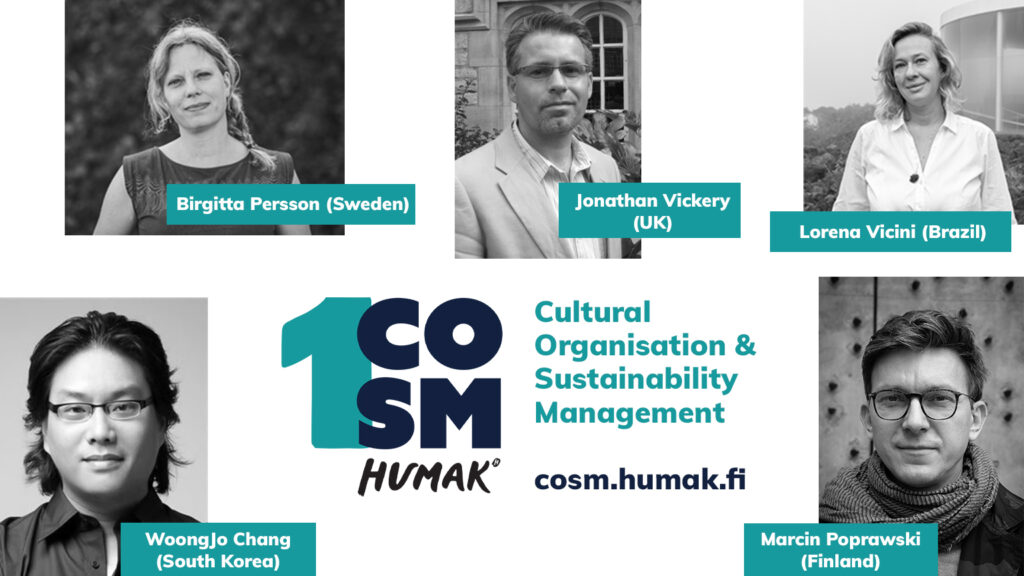
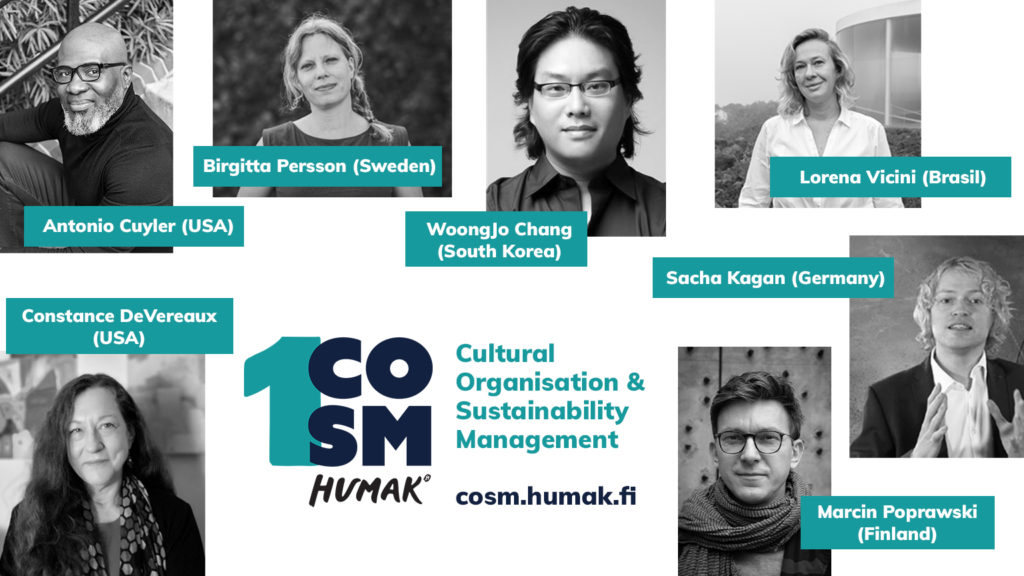
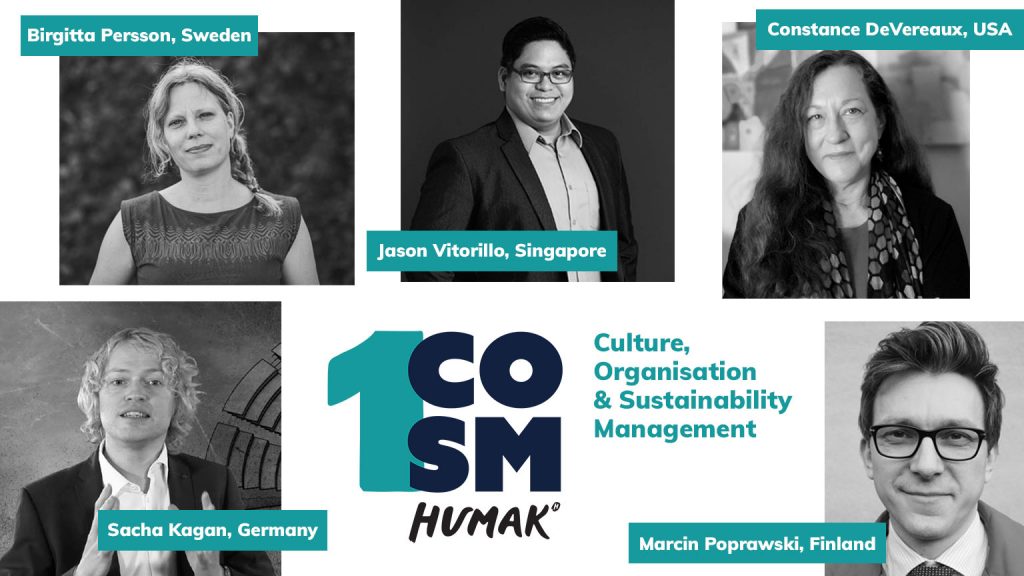
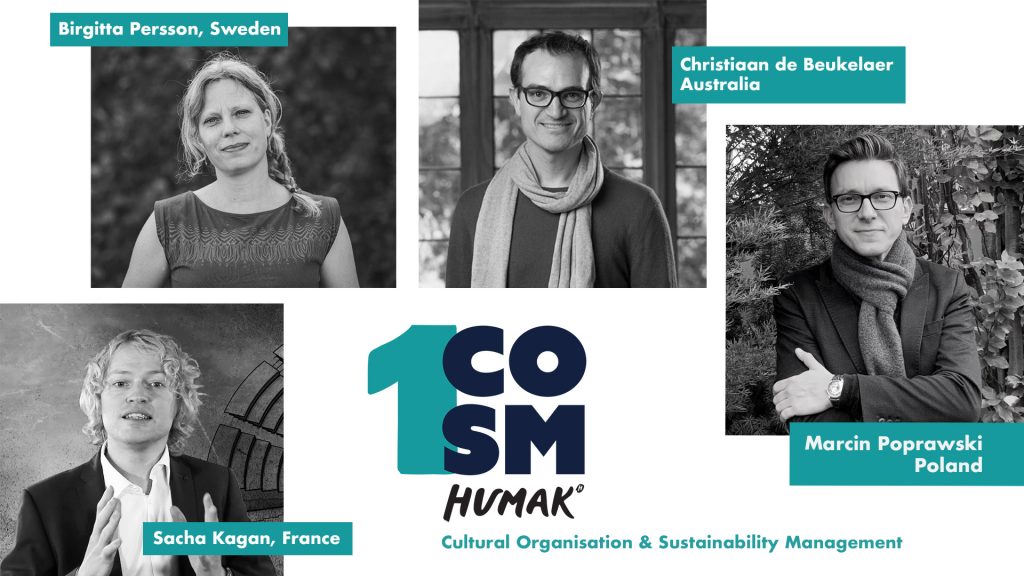
Guest lecturers (1st-7th editions):
Birgitta Persson (Future by Lund, Lund, Sweden)
Sacha Kagan (Leuphana University, Luneburg, Germany)
Christiaan de Beukelaer (University of Melbourne, Australia)
Jonathan Vickery (University of Warwick, UK)
Constance DeVereaux (University of Connecticut, USA)
WoongJo Chang (Hongik University, Seoul, South Korea)
Antonio Cuyler (University of Michigan, USA)
Jason Vitorillo (Lasalle College of the Arts, Singapore)
Lorena Vicini (Instituto Inhotim, Belo Horizonte, Brazil)
Host lecturer:
Marcin Poprawski (Humak University of Applied Sciences, Helsinki, Finland)
COSM 2 “Cultural Entrepreneurship and Sustainability Management” (2021-2025) was a 5 ECTS course that provided an international and cross-disciplinary perspective on sustainability values and practical dimensions of cultural managers’ work. There were three central domains of cultural producers’ activities discussed in the course: festivals, and local communities-oriented productions and other independent entrepreneurial initiatives in rural and urban environments. This course was selected as a separate unit or as a second part of the whole COSM series of three courses (15 ECTS).
Content
- Cultural Entrepreneurship and Sustainability Values
- Sustainability and the nature of Cultural Projects and Creative Processes
- Festivals and Sustainability
- Cultural NGOs as Sustainability actors
- Creative Partnerships for Environmental, Social and Economic Sustainability
Amongst carefully selected and invited experts and guest lecturers who shared their experience and knowledge through COSM 2 were inspiring individuals with the work experience in Finland, the United Kingdom, Jamaica, Australia, Sweden, United States, Philippines and Poland.
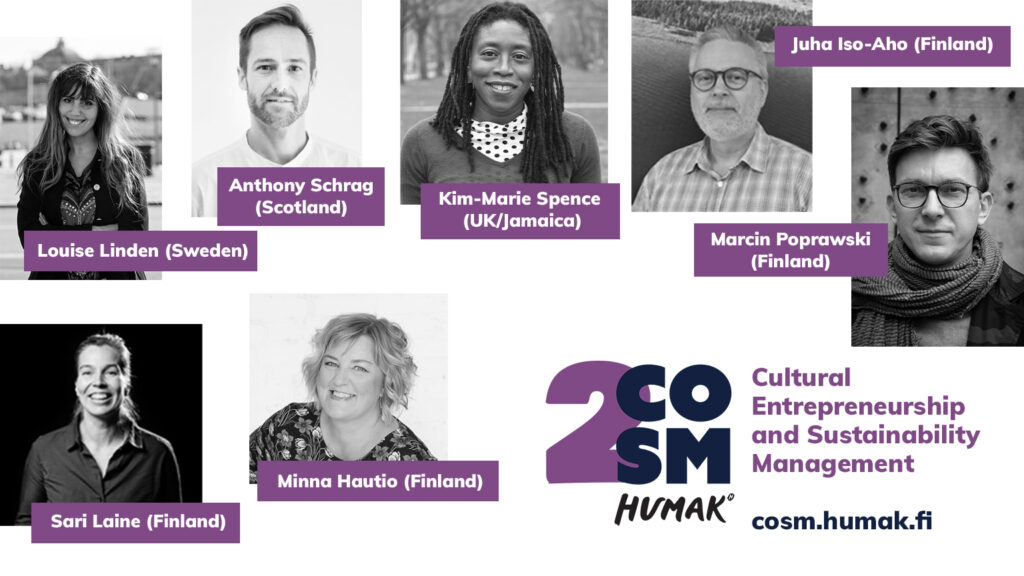
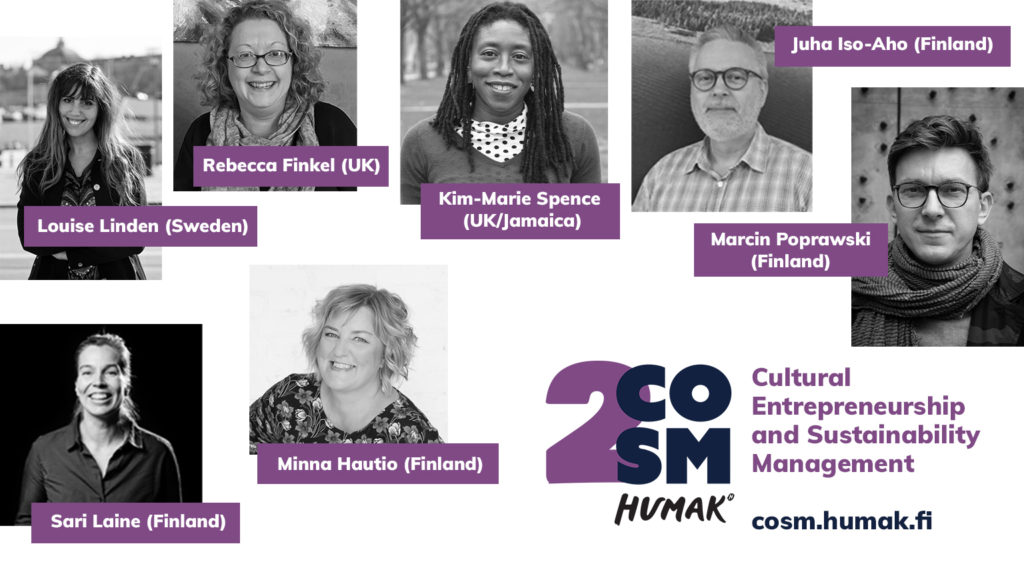
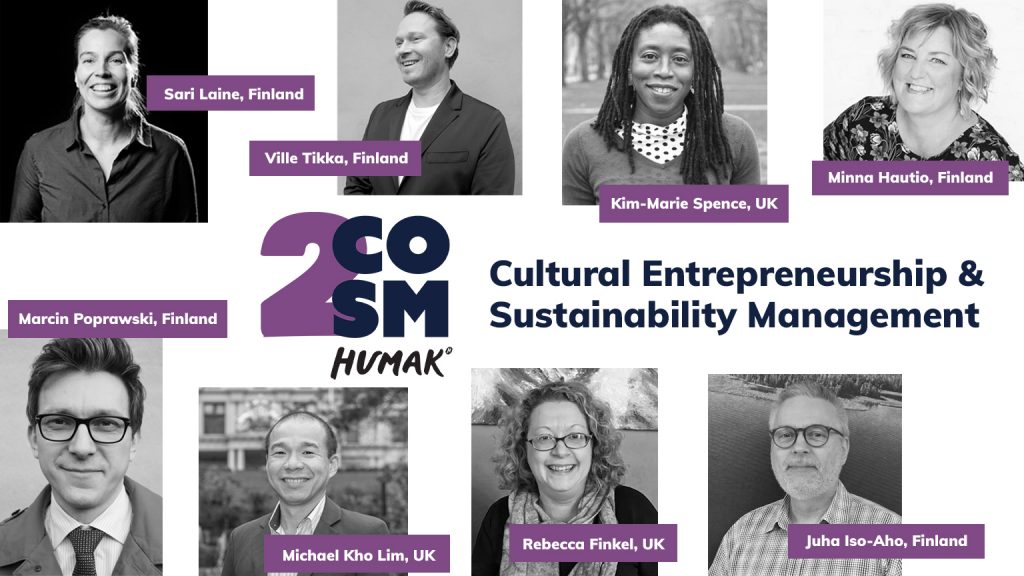
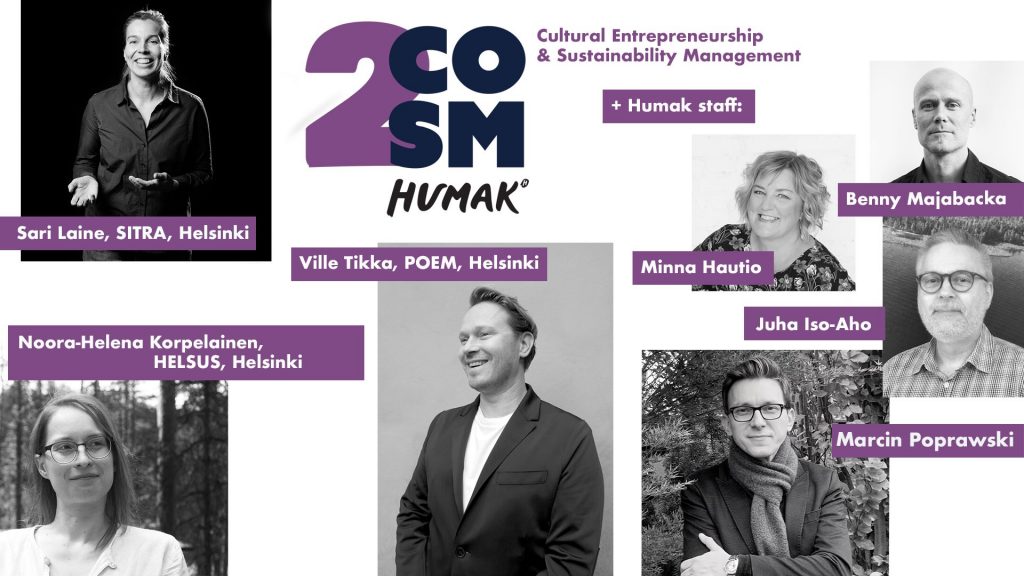
Guest lecturers (1st-7th editions):
Rebecca Finkel (Queen Margaret University Edinburgh, UK)
Ville Tikka (Poem, Helsinki, Finland)
Michael Kho Lim (University of Glasgow, UK)
Anthony Schrag (Queen Margaret University Edinburgh, UK)
Minna Hautio (Humak University of Applied Sciences, Helsinki, Finland)
Kim – Marie Spence (Queen’s University, Belfast, UK)
Juha Iso-Aho (Humak University of Applied Sciences, Helsinki, Finland)
Sari Laine (SITRA, Helsinki, Finland)
Noora-Helena Korpelainen (University of Helsinki, Finland)
Louise Linden (LiveGreen Festivals, Stockholm, Sweden)
Benny Majabacka (Humak University of Applied Sciences, Turku, Finland)
Host lecturer:
Marcin Poprawski (Humak University of Applied Sciences, Helsinki, Finland)
COSM 3 “Cultural Management & 3 Dimensions of the Sustainability: Environmental, Social & Economic” (2021-2025) was 5 ECTS course that provided an international and cross-disciplinary perspective on cultural management and sustainability values, engaging the expertise from abovementioned research areas of sustainability. Its aim was to acknowledge, adapt and strengthen the role of cultural managers in supporting the general sustainability movement, impacting people’s and industries’ pro-ecological behaviours, assisting all types of attempts to make our life more sustainable, ethical, responsible, or balanced – in environmental, social, and economic sense. And finally, this part of the module was also questioning the answers regarding cultural organizations and cultural professionals’ role in balancing their cultural ecosystems. This course was selected as a separate unit or as a third part of the whole COSM series of three courses (15 ECTS).
Content
- Thresholds. Social dimensions of sustainability and audience-centric cultural public spaces
- Beyond prepositions, assumptions and contradictions. Culture in, for or as Sustainability
- Audience engagement, cultural management and sustainability values
- Environmental and urban planning dimensions of sustainability and the role of cultural Ecosystems.
- Social dimensions of Sustainability – Fair international cooperation – cultural production – cultural policy
- Inter-generational aspect of sustainability – cultural management applications
- Economic sustainability through cultural management lenses – global and local perspective
- Cultural Tourism and Sustainability
- Aesthetics and Sustainability
- Cultural matters on the edge of protection and free access, conservation and change
Amongst carefully selected and invited experts and guest lecturers who shared their experience and knowledge through COSM 3 were inspiring individuals who worked in Finland and Japan, Italy, Scotland, Cambodia and Portugal, Canada, Germany and Poland:
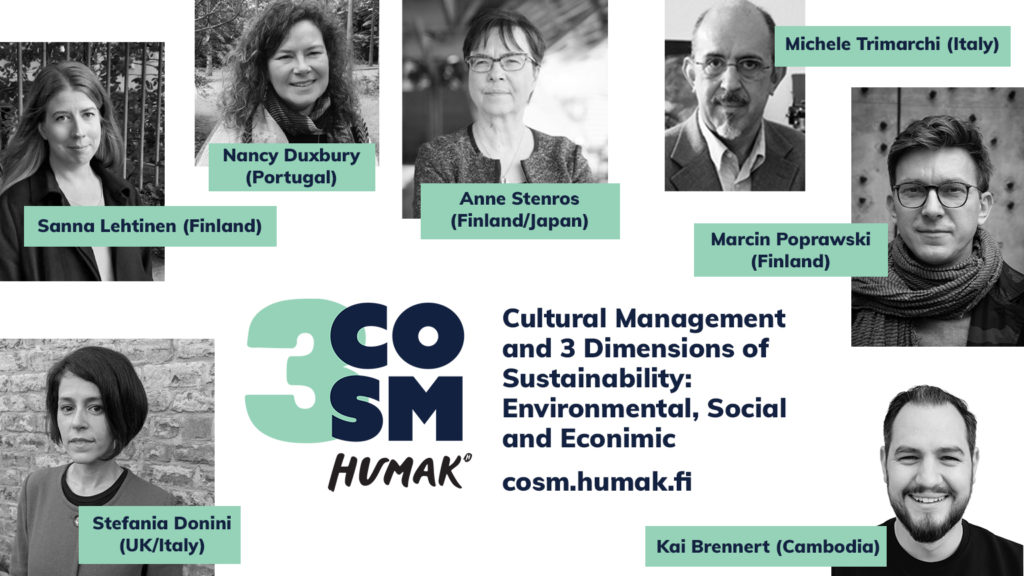
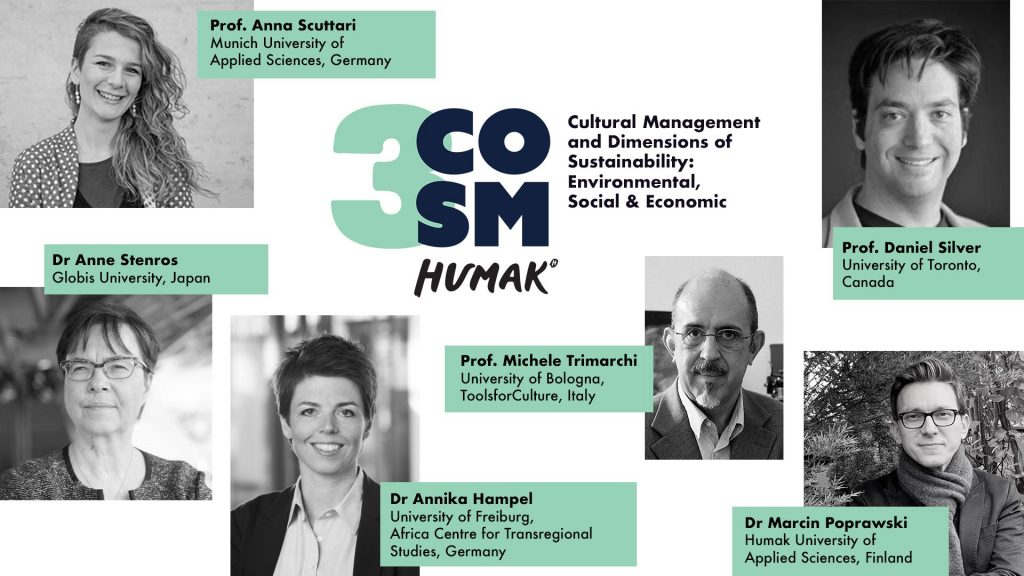
Guest lecturers (1st-7th editions):
Kai Brennert (edge and story, Phnom Pen, Cambodia)
Anne Stenros (Globis University, Tokyo, Japan // Creative Catalys Oy, Helsinki, Finland
Michele Trimarchi (Tools for Culture, Rome, Italy)
Annika Hampel (University of Freiburg, Germany)
Daniel Silver (University of Toronto, Canada)
Nancy Duxbury (University of Coimbra, Portugal)
Sanna Lehtinen (Aalto University, Helsinki, Finland)
Anna Scuttari (Munich University of Applied Sciences, Germany)
Stefania Donini (Paisley Museum, Scotland, UK)
Host lecturer:
Marcin Poprawski ((Humak University of Applied Sciences, Helsinki, Finland)
Participants who accomplished all three COSM courses (1+2+3, 15 ECTS) were granted with a special final certificate / document confirming their expertise in Culture and Sustainability